Archive

Tag Archives: team

I’ve been working with agile now for a few years and I do find that often it is misunderstood massively within organisations. This is mostly the reason businesses just never get the benefits from an agile approach to delivery of projects. In many ways it just seems too simple but the reality is that positive adaptation of agile is really challenging because it takes engagement. How can I put this clearly?

Agile is not a thing you take out of a box and just let go and be free. It is like a new puppy, it needs training and nurturing and in many ways loving. It takes consistency and effort and establishment of some solid ground rules.

Any excuse to put in a photo of the puppy, when he was a puppy…

It takes responsibility to wield agile with purpose and it takes the involvement of the whole organisation, not just the poor development team. After all the benefits of agile that is working will be realised by everyone.

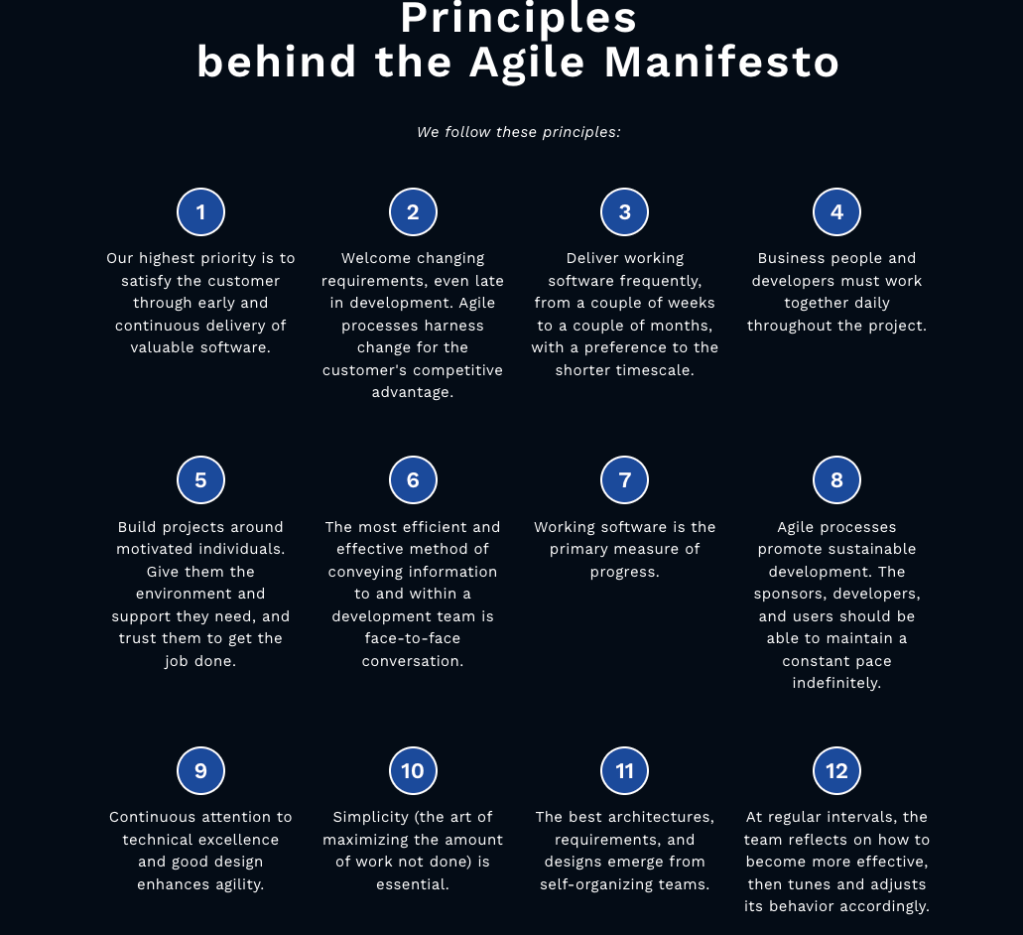
All too often I hear simple statements of the purpose of agile and yet the foundations of agile are covered by the manifesto and principles. For those unsure about them they are here;
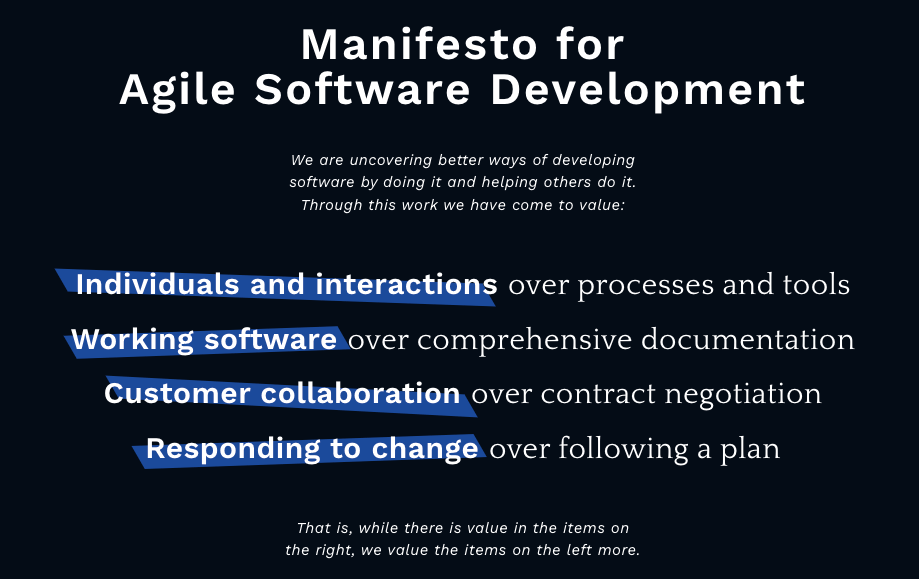
There is a lot here to digest and if you do not come up with questions and searches for clarity then you need to read them again. I don’t believe they were ever intended as a complete answer and there is a lot to dig into. Each principle for example will need careful consideration and unpicking. I will start to go through the principals one at a time in later editions.

The fact remains that using the word ‘agile’, is in my humble opinion the laziest starting point and having read ‘Make work more fun’, by the corporate rebels gave me an insight that the businesses that seem to be excelling in agile practices are the ones who don’t call themselves ‘agile’.

“Don’t do agile, be agile…”

So what do I mean about staying light on your feet? Simply, although there is a lot of complexity around making agile work, the fundamentals are that the purpose of an agile approach to project delivery is that you don’t continue to invest in projects where the cost of implementation cannot realistically be realised by the work being carried out. Understanding and being clear about the value objectives and also being realistic about the benefits are one thing. The other main element of agile is that more is unknown at the beginning of the project and as more details come to light the greater the understanding is to identify the realities of the value. As the team learn more and share their knowledge, the better they set to be honest about the benefits to the customer and the users. Why waste precious time doing work that will not pay the dividends?

Of course this puts a very simplistic perspective on the problem because not all effort can be measured in financial rewards directly as there are often works that must be completed from a strategic perspective. Moving products to the cloud for example, although there should be an element of value, there could also be a stability or benefits from cloud support elements that are a factor too and the longer term impact needs to be taken into consideration.

This is why it is so important (more so), that organisations are fully transparent about its objectives and strategy. I do love simple goals and objectives, so that they can remain in the forefront of peoples memory but this has to be enhanced by deeper and more complex understanding of the complexity. Life is never simple, but having a heading that is simple to understand and backed up by greater knowledge will enhance the teams ability to ask those difficult questions when value is This is why it is so important (more so), that organisations are fully transparent about its objectives and strategy. I do love simple goals and objectives, so that they can remain in the forefront of peoples memory but this has to be enhanced by deeper and more complex understanding of the complexity. Life is never simple, but having a heading that is simple to understand and backed up by greater knowledge will enhance the teams ability to ask those difficult questions when value is getting close to being unrealised.


As a practitioner in AgilePM, a professional Scrum Master and working in the role of an Agile delivery manager, I don’t consider myself an expert. If I did I would probably remain lost in the sea of Agile experts. There are a lot. Although I’m unsure exactly what an expert is. Feel free to let me know if you have any insight.

The idea that ‘Agile’ is order is not respecting the environment where it operates.

I have mentioned before the belief that many people who consider themselves ‘Agilists’ do so to fit into the crowd without really getting the point. Another misconception about ‘Agile’, is its simplicity! It’s a piece of cake… Go away for a couple of days or a week on a course and the little bit of knowledge starts to open up the possibility of what it can produce. It it’s no secret that it can be an incredibly valuable method / mentality / idea / thing / whatever… It certainly seems to work well in a development / software environment, but it is far from simple when it comes to implementing it.

When you look at it as a Scrum team or other small team working towards a valuable product, it looks pretty simple, and those diagrams do a good job of making it appear simple, but that is their job.

The problem is though, ‘Agile’ does not operate in a sterile bubble, where communications are controlled on rails and everyone knows exactly what they and their whole team are doing down to the minuscule detail and management sit in their offices comfortable that the scrum team is producing immense value every iteration.

If only it was that simple…

Now, I don’t have the solutions for you, I told you I’m not an expert, all I do know is that I have looked at an organisation in. the past and said to myself, “Agile would really work well there!”, and then the real work begins. You don’t have to have a vision as to how it will ultimately look, because, the point is that true ‘Agile’ adapts to and around the team, as long as it’s understood and respected enough. I mean, have you ever truly thought about exactly what an empowered team looks like? It’s about the loss of control and ultimate trust, mountains of trust and that subject is a blog post in itself.

How many times have you managed a team that was a carbon copy of the team before?

Thats right and the primary reason a lazy, formulaic approach to ‘Agile’ will be doomed to fail, it will never get to perfection for more than a moment and some dynamic or other messes with it.

It will always and constantly need attention and love to succeed. It’s just not simple to organise a group of human beings into a performing team by just reading a few pages in a text book. It’s a challenge, a rewarding challenge at times, but a challenge all the same..

But, you know what? It might just be worth that effort…

Nature around the garden demonstrates efficient symbiosis. The importance of this connection is not visible or understood by everyone, but ignorance has no relation on it’s importance. Photographer: Mark Nesbit

Nature over time has created an effective and efficient interoperability. Without insects, flowers would not be pollinated, fruit would not grow and the future of these species would be in doubt.

In the business world, we need this level of connectivity, or expect it and more often than not assume it. We build teams, plan meetings and activities and pretty much assume that this is all automatically universally understood and absorbed.

Under the Covid19 restrictions, I see people sitting in more and more meetings, all from home, where we are surrounded by distractions (family issues, bored kids, noise, the broken dishwasher, the list never ends), however all those meetings (I had five yesterday) we are expected to maintain 100% focus. The formats are dull, unimaginative and often pointless or even worse, aimless! Then we are expected to act on them. It’s insanity at times.

Connections must be efficient and effective, otherwise they should be cut. This sounds easy, but often not. I have meetings on in the background as I continue to work now as they track the telephone numbers of those dialling in.

At the start of this Covid journey, I got it. A strange situation, people working from home, we needed to keep an eye on each others mental health, make sure everyone was engaged. The perils of isolation were identified early on.

You need an element of trust towards your work force. The flower doesn’t complain or sulk when a bee passes by without stopping. Another bee from the hive has or will pick up the nectar…

I mean that meetings are not the only way to communicate, there are more effective methods for certain things.

If any of your have your own Covid meeting stories, I’d love to hear them.

Around the garden feel alone and isolated. Photographer: Mark Nesbit, LIMEfotographic / Marking Time Photography

Today I want to talk briefly about teams, their importance and how, often they are taken for granted.

What is a team? Well, put simply it is a group of individuals working to a common goal or objective with synergy. Of course there are many different types of teams, from sports teams to software developing teams, to Infantry sections and Government teams. They all have different objectives and structures but the fundamentals of good team skills are similar.

Well I know we all understand that there are always effective team and some that are, not so much. We have probably all worked on a team that wasn’t working effectively? There can be many reasons for this but most can be addressed. Clearly this article can’t cover the whole subject.

There are some important considerations at a base level though.

  1. What is the common goal / objective and it it really understood by everyone and are they aware of what their part is in achieving it?

It seems so straightforward, but in my experience, this is one of the most common errors. Confusion and lack of clarity will make team members fill in the gaps which often ends up in team members pulling in different directions or simple standing still, not knowing which way to go.

2. Does each member feel part of the team?

Teams should be organic, they grow and evolve, but some times this can be in a negative way. Dysfunction is a form of function that can come from even one team member that feels isolated. Be aware of the team, the unity takes constant effort and attention that can easily be missed in a busy department.

3. Are there consistent and effective methods of communication adopted?

Seeing this written down, it’s a no brainer, however most team leaders believe that their teams have this down. The reality though is much different. As a team leader, can you categorically say that each member of your team has a voice (that is heard), feels safe (to bring up their ideas), feels respected (given credit for their efforts)? The right methods of communication carried out effectively will certainly be a starting point to building a better team.

There are many ways to fix a team and in most cases there are improvements to be made. Teams can go through constant transitions or change and new members can often be expected to find their own way in. Find their own fit. I saw this happen all the time in the military. In my experience this can work but it certainly is not efficient.

Like always, I would love to hear your thoughts and experiences.

If you like this blog post or any of the others, please click like and share.

Covid has not affected everyones productivity.

Like pretty much everyone else, Covid19 has affected their work lives, the ‘work from home’ scenario should be in full swing now. For most, it has been a change, some for the better and others… well you know?

I must admit, that for me it started pretty well. I could see better communication within the department although the down side was more meetings I did not ‘need’ to be at.

I think that when changes in the work place occur, either by design or necessity, it is very important to keep checking. What starts off as progress can soon lead to complacency and turmoil if not unchecked.

In particular, in these circumstances, when there is such massive change in an organisation, it is important to be heard. Your opinion counts and if you are having issues with a process (they are not working for you), it is better to address them directly and positively than just letting them go on. The chances are, others are feeling the same but possibly don’t have the courage to bring up the problem.

Stay strong, stay polite (although you may not always feel like it), and remember that a team is only as strong as its weakest member.

We all have our imperfections but it does not mean we are useless.